By Legal Correspondent
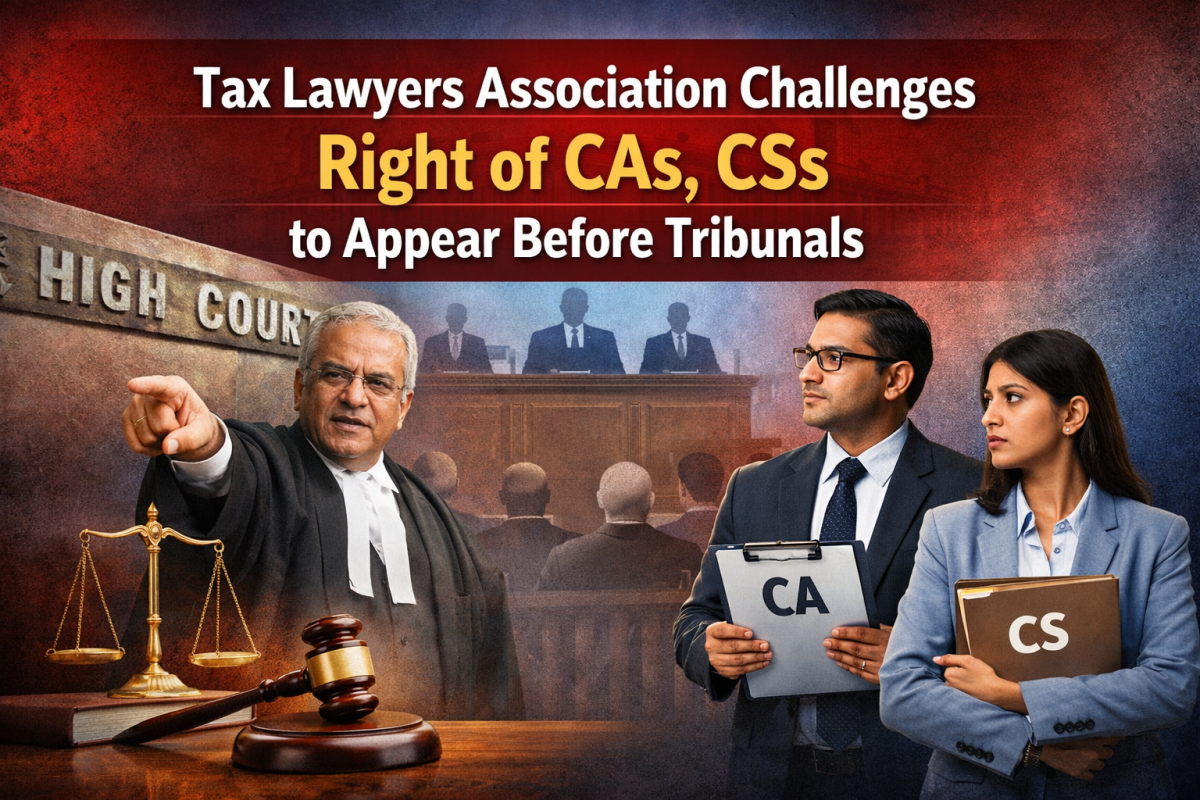 NEW DELHI, February 18, 2026 — The Bar Council of India (BCI) and the Association of Tax Lawyers have submitted before the Delhi High Court that Chartered Accountants, Company Secretaries, Cost Accountants, and other professionals who are not enrolled as advocates cannot appear before tribunals or plead cases on behalf of clients.
A division bench of Justice Prathiba M. Singh and Justice Madhu Jain was hearing three connected petitions—W.P.(C) 2360/2005, W.P.(C) 4003/2017, and W.P.(C) 541/2020—which raise the question of whether non-advocate professionals have the right of audience before judicial and quasi-judicial forums.
Core Legal Question
The petitions, pending before the court for varying periods with the oldest dating back to 2005, seek to determine whether persons lacking enrolment under the Advocates Act, 1961, can represent clients before tribunals. The class of professionals in question includes Chartered Accountants, Company Secretaries, Cost Accountants, and other individuals with similar qualifications, regardless of whether they possess an LL.B. degree.
Petitioners' Submissions
Appearing for the Association of Tax Lawyers, Senior Counsel Mr. Rajeev Saxena took the court through various statutory provisions, including the Advocates Act, 1961, the Chartered Accountants Act, 1949, and the Code of Civil Procedure, 1908.
The submissions made on behalf of the petitioners are as follows:
Exclusive Right of Advocates: Section 30 of the Advocates Act, 1961, confers upon advocates the right to practice before all courts, tribunals, and other authorities. According to the petitioners, this provision read with Section 33 of the Act restricts the right of audience to enrolled advocates.
Prohibition on Unauthorized Practice: Section 33 of the Advocates Act states that no person shall be entitled to practice in any court or before any authority unless they are enrolled as an advocate under the Act. The petitioners contend that this bars Chartered Accountants, Company Secretaries, and other professionals from appearing before tribunals.
Penal Consequences: Drawing attention to Section 45 of the Advocates Act, the petitioners submitted that any person who practices in courts, tribunals, or other authorities in contravention of the Act is punishable under the law. This provision, it was argued, underscores the legislative intent to restrict legal practice to qualified and enrolled advocates.
Conduct of Evidence: The petitioners further submitted that before any forum possessing the power to record evidence, only advocates can practice and conduct such proceedings. The right to examine and cross-examine witnesses, it was argued, is intrinsically linked to legal training and enrolment.
Respondents' Position
On behalf of the other professionals, including Chartered Accountants, Company Secretaries, and Cost Accountants, it has been argued that Section 432 of the Companies Act, 2013, read with relevant Practice Directions and Rules of various Tribunals, permits them to represent their clients. Statutory recognition under specialized enactments, according to this view, creates an exception to the general regime of the Advocates Act.
Challenge to Section 432 of Companies Act
W.P.(C) 541/2020, originally filed by Purav Middha, has challenged the constitutional validity of Section 432 of the Companies Act, 2013. The court was informed that the original petitioner has passed away. Mr. Ashish Middha was permitted to implead himself as the petitioner and either argue the matter personally or engage another advocate.
Proceedings on February 16
During the hearing conducted through hybrid mode on February 16, 2026, Mr. Rajeev Saxena, learned Senior Counsel, sought time to prepare a written note of arguments, which was granted by the court.
Mr. Preetpal Singh, learned Counsel appearing for the Bar Council of India, informed the bench that he was out of station due to a wedding in the family and requested an adjournment to enable his physical presence for arguing the matter.
Court's Directions
Acceding to the requests, the bench adjourned the matter to March 16, 2026, directing that it be listed at the end of the 'Supplementary list'.
The court permitted any counsel wishing to file additional written submissions or modify existing ones to do so at least two weeks before the next hearing. Copies of all written submissions are to be exchanged between the parties.
The bench explicitly stated that no further adjournment shall be granted in these matters. The cases have been categorized as "part-heard."
Significance
The outcome of these petitions will have implications for the professional landscape in India. A ruling in favour of the Bar Council and Tax Lawyers Association could potentially restrict the scope of practice for thousands of Chartered Accountants, Company Secretaries, and Cost Accountants who currently appear before various tribunals, including the National Company Law Tribunal (NCLT), the Debt Recovery Tribunal (DRT), and income tax appellate authorities.
Conversely, a ruling upholding the rights of these professionals under specialized statutes would recognize a parallel system of representation before quasi-judicial bodies.
The matter now stands listed for further hearing on March 16, 2026.