Citation: 2026 INSC 361
If there is one judgment that beautifully captures the tension between what a contract says and what it actually means when money is on the line, this is it.
As Company Secretary students, we spend hours studying the Indian Contract Act, arbitration law, and the nuances of consent awards. But honestly? Nothing makes it click like a real dispute where two smart parties read the same clause in completely opposite ways.
Let me break down this Supreme Court decision in plain language—because this is exactly the kind of practical issue you will face when drafting or reviewing settlement agreements.
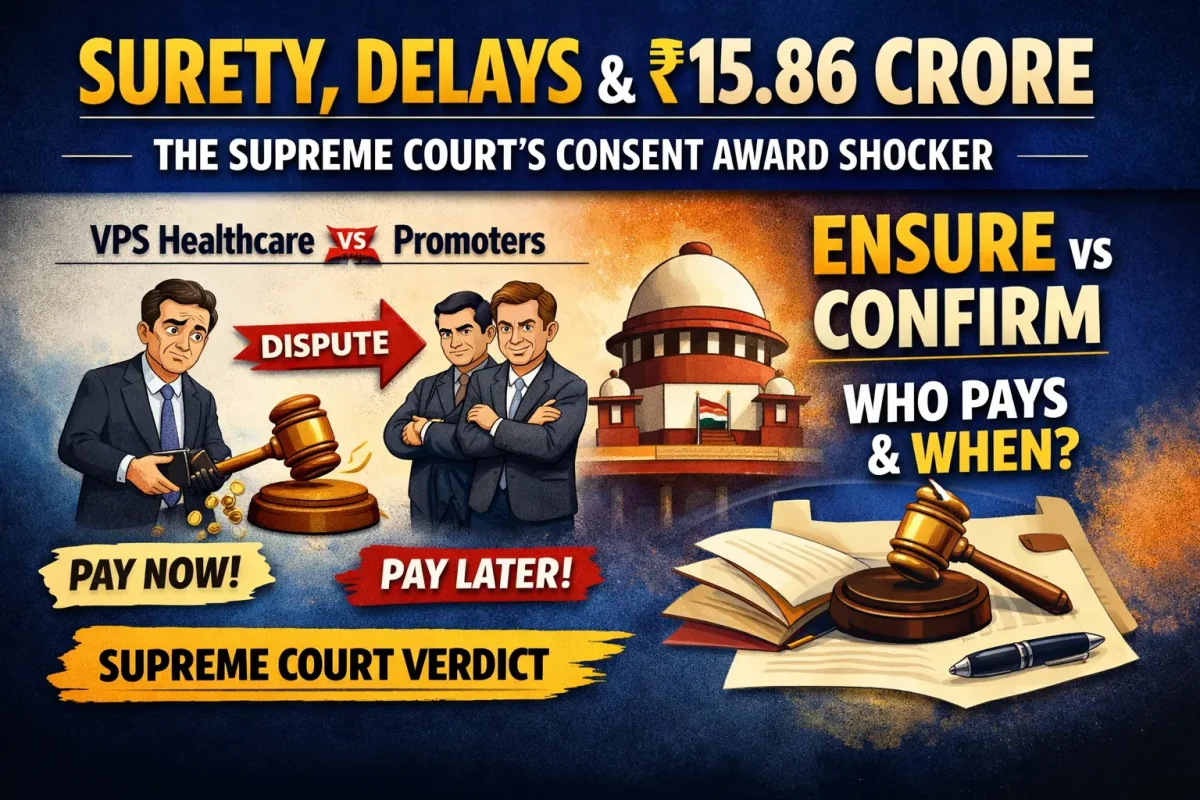
The Backstory (In Simple Terms)
Picture this:
-
VPS Healthcare buys Rockland Hospitals (later renamed Medeor) from its promoters (Mr. Prabhat and Mr. Rishi Srivastava).
-
Before the sale, Rockland had hired Ernst & Young (EY) for some work. Later, EY demanded ₹10 crore + interest. Dispute arises.
-
VPS and the promoters fight over many things. Finally, they sit down and sign a Deed of Compromise on February 2, 2019.
-
This compromise is converted into a Consent Award by the Singapore International Arbitration Centre (SIAC) on March 1, 2019.
So far, so good. Everyone agreed. Case closed? Not exactly.
The Problem Clause (Where the Trouble Starts)
The Consent Award had a paragraph (clause 32(a)) that said two important things:
Part A (The "Protect Now" Part)
"The promoters will ensure that no liability regarding the said litigation is recovered from VPS/Medeor by any Forum."
Part B (The "Pay Later" Part)
"In case any liability is confirmed by the Highest Court of Appeal, the same will be discharged by the promoters within 30 days."
Seems clear enough? Wait.
An arbitration tribunal later awards ₹15.86 crore to EY against Medeor. Medeor challenges this award in the Delhi High Court. The High Court says: "Fine, we will stay the execution, but Medeor, you must deposit the entire amount first."
Medeor deposits the money under protest. Then it turns to the promoters and says: "Your turn. Pay us back. You promised to ensure no liability is recovered from us."
The promoters smile and say: "Not so fast. The 'Highest Court of Appeal' hasn't confirmed anything yet. We will pay only after the Supreme Court says so."
What the Delhi High Court Said (And Why It Made VPS Angry)
The High Court looked at the clause and said:
-
The promoters are right. The agreement clearly says payment will happen after the highest court confirms the liability.
-
Right now, the matter is still in appeal. So enforcement is premature.
-
The clause is essentially a contract of indemnity, and the trigger is final confirmation.
VPS felt cheated. It had deposited ₹15.86 crore of its own money, and the promoters were happily litigating on VPS's name (using a power of attorney) while delaying their own payment obligation. So VPS went to the Supreme Court.
What the Supreme Court Said (Finally, Some Clarity)
The Supreme Court did something very simple yet powerful: it read the entire clause together instead of picking one sentence and ignoring the other.
1. "Ensure" is a strong word
The Court said the word "ensure" in Part A is not a soft suggestion. It is an absolute obligation. The moment any forum (court, tribunal, authority) recovers any money from VPS, the promoters have to step in. No excuses.
2. The "Pay Later" part is only for the endgame
The part about "confirmation by the Highest Court of Appeal" is not the only trigger. It is a backstop—a guarantee for the worst-case scenario where the liability survives all appeals up to the Supreme Court. It does not cancel the immediate duty to protect VPS from any recovery.
3. The High Court created a paradox
The Supreme Court pointed out a clever flaw in the promoters' logic:
If the promoters only have to pay after the Supreme Court confirms the liability, what stops them from simply not appealing to the Supreme Court?
Exactly. If they never take the case to the highest court, no confirmation ever happens, and they never pay. That cannot be what both parties intended when they signed the compromise.
4. Depositing money = Liability recovered
The Court held that when the Delhi High Court ordered Medeor to deposit ₹15.86 crore, that itself was a "liability recovered by a forum." The fourth limb of the clause was triggered right then.
The Final Order (What Happened in the End)
The Supreme Court:
-
Set aside the Delhi High Court judgment.
-
Allowed VPS to enforce the Consent Award immediately.
-
Gave the promoters 30 days to pay ₹15.86 crore to VPS.
-
Added a practical condition: if VPS ultimately wins its challenge against the EY award, the promoters can take the bank guarantee from EY. So no one gets unjustly enriched.
No costs were awarded. The Court clearly wanted to resolve the legal principle, not punish anyone.
Why This Matters for CS Students
Let me be honest. As CS students, we are not just expected to memorize sections. We are expected to spot risks in contracts before they become disputes.
Here are three practical takeaways from this case:
1. Watch out for conflicting timelines in indemnity clauses
If you are drafting a settlement agreement or a consent award, do not put an immediate protection obligation next to a deferred payment obligation without clarifying which one wins. The courts will try to give effect to both, but that may not be what your client wants.
Better drafting:
"The Promoters shall, within 7 days of any demand, reimburse the Company for any amount recovered by any court or tribunal, regardless of whether such recovery is interim or final. The obligation to pay after final confirmation by the highest court is separate and additional."
2. "Ensure" is a dangerous word for the promisor
If you are advising a client who is agreeing to "ensure" something, tell them: the court will treat this as an absolute obligation. There is no hiding behind "but the other clause says something else."
3. Consent awards are contracts with a judicial stamp
Do not assume that because something is a "consent award," it is flexible. The Supreme Court made it clear: executing courts are not there to rewrite your bargain. They are there to enforce it. So get the drafting right the first time.
A Note on the Indemnity Angle
The High Court had treated the clause as a pure indemnity contract under Sections 124–125 of the Contract Act. The Supreme Court did not fully reject that, but it added an important nuance:
An indemnity holder can sue as soon as a liability is incurred, not only after actual loss is suffered.
This comes from the old Bombay High Court case Khetarpal Amarnath v. Madhukar Pictures, which the Supreme Court approved. So if you are drafting an indemnity clause, remember: the trigger can be incurring liability (like a court order to deposit money), not just paying it.
Final Thoughts
This judgment is a goldmine for anyone preparing for CS Executive or Professional exams, especially for papers on:
-
Arbitration and Conciliation Act, 1996 (enforcement of consent awards under Section 36)
-
Indian Contract Act, 1872 (indemnity, absolute obligations)
-
Drafting and interpretation of commercial documents
More than that, it is a reminder that words matter. "Ensure" and "confirm" sound similar, but in court, they can mean the difference between getting paid today and waiting for years.
As future governance professionals, our job is to catch these subtle differences before the agreement is signed. That is where we add real value.
source:- Supreme Court of India