Landmark Judgment Recognizes Motherhood Beyond Biology, Upholds Equality and Child Welfare
NEW DELHI, March 17, 2026: In a significant judgment delivered today, the Supreme Court of India declared that the three-month age limit imposed on adopted children for availing maternity benefits is unconstitutional. The Court held that denying maternity leave to women who adopt children older than three months violates the fundamental rights to equality and a dignified life under Articles 14 and 21 of the Constitution.
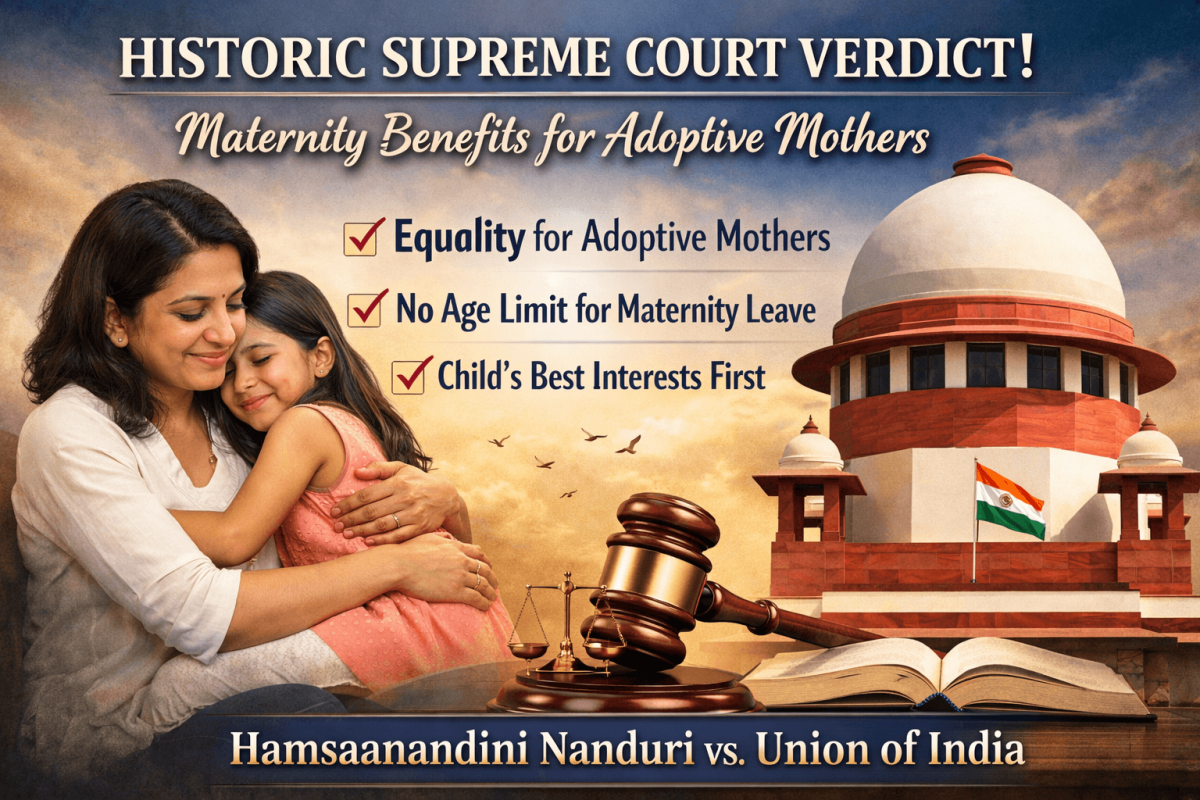
A bench comprising Justices J.B. Pardiwala and R. Mahadevan struck down Section 60(4) of the Code on Social Security, 2020—which had re-enacted the provision from the Maternity Benefit (Amendment) Act, 2017—to the extent that it restricted benefits to adoptive mothers whose children were below three months of age.
The Challenge
The petition was filed by Hamsaanandini Nanduri, an adoptive mother of two children, who challenged the age restriction as arbitrary and discriminatory. The provision entitled only those mothers who legally adopt a child below three months to twelve weeks of maternity benefit from the date the child is handed over.
"The distinction created by the legislature between a woman who adopts a child aged less than three months and a woman adopting a child aged three months or above is artificial," argued Ms. Bani Dikshit, counsel for the petitioner. "If a woman adopts a child aged four months, she would not be entitled to any maternity benefit whatsoever."
Rationale Behind the Judgment
Motherhood Beyond Biology
The Court expansively interpreted the concept of motherhood, emphasizing that it is not confined to biological processes. Quoting poet Fleur Conkling Heyliger, the judgment observed: "Not flesh of my flesh, nor bone of my bone, But still miraculously my own. Never forget for a single minute, You didn't grow under my heart, but in it."
"Maternity benefit or the payment in lieu of such leave is intended to support women during the phase of early motherhood by providing economic security when they are most engaged in the care and nurture of a young child," the Court noted. "This act of support recognizes that motherhood entails sustained physical, emotional, and social exertion which demands time, financial stability and resources."
Three Components of Maternity Leave
The Court identified three essential components of maternity leave:
-
Time necessary for physical recovery following childbirth (concerns both mother and child)
-
Time required to nurture and develop emotional bonds between mother and child
-
Time necessary to attend to the child's physical and emotional needs and facilitate family integration
While acknowledging that the first component is absent in adoption cases, the Court held that "the second and third component are present and significant." The very inclusion of adoptive mothers in the provision recognizes the importance of these non-biological aspects of motherhood.
Violation of Equality
Applying the test of permissible classification under Article 14, the Court found the three-month limit arbitrary and unreasonable. "The classification between a woman adopting a child aged less than three months and a woman adopting a child aged three months or more is artificial and violative of Article 14," the judgment stated.
The Court observed that women who adopt children aged three months or above are similarly situated to those adopting younger children "insofar as their roles, responsibilities, and caregiving obligations are concerned." The essential attributes of adoptive mothers do not undergo material change merely on account of the child's age at adoption.
"The purpose of maternity leave neither varies with the nature of employment nor with the manner in which the child is brought into the life of the mother," the Court emphasized.
Reproductive Autonomy and Child Welfare
The judgment expansively interpreted reproductive autonomy under Article 21 to include adoption. "Adoption, too, represents a conscious and meaningful exercise of the choice to create and nurture a family, and must be viewed as falling within the broader spectrum of reproductive decision-making," the Court held.
Applying the principle of "best interest of the child"—a cornerstone of the Juvenile Justice Act and international conventions—the Court emphasized that this consideration "does not conclude with the completion of the formalities of adoption or the handing over of custody of the child to the adoptive parents. It is a continuing obligation that persists throughout the period a child remains a child."
Practical Unworkability
The Court also examined the provision's workability, noting the mandatory timelines under the Juvenile Justice (Care and Protection of Children) Act, 2015, and the Adoption Regulations, 2022. The process for declaring a child legally free for adoption—including efforts to trace biological parents and reconsideration periods for surrendering parents—takes at minimum two months or more.
"By the time a child is declared legally free for adoption, the child is unlikely to remain within the narrow age threshold contemplated by the provision," the Court observed. "Although the statute ostensibly confers maternity benefit upon adoptive mothers, yet the benefit remains largely inaccessible in practice."
International Perspectives
The Court drew upon international jurisprudence, including decisions from the Constitutional Court of South Africa and the European Court of Human Rights. In Werner Van Wyk v. Minister of Employment and Labour, the South African Constitutional Court had struck down a similar age cap of two years, observing that "parental leave, irrespective of the child's age, is not solely about meeting the needs of the child, such as nurturing, but also to allow children of different ages a period to integrate and adapt in the new family unit."
Observations on Paternity Leave
In a significant aside, the Court highlighted the importance of paternity leave, calling for legislative attention to this issue. "The early months and years of a child's life constitute a formative period during which emotional bonds, attachment, and a sense of security begin to take shape. During this stage, the presence of a father contributes significantly to the child's emotional and psychological well-being."
The Court noted that the absence of paternity leave "reinforces gendered roles in parenting" and deprives willing fathers of meaningful opportunities to contribute. "When fathers are afforded the opportunity to take leave following the arrival of the child, they are able to support mother and share family responsibilities."
The Revised Provision
The Court directed that Section 60(4) of the Code on Social Security, 2020, be meaningfully read as:
"(4) A woman who legally adopts a child or a commissioning mother shall be entitled to maternity benefit for a period of twelve weeks from the date the child is handed over to the adopting mother or the commissioning mother, as the case may be."
The age limit of three months was thus removed entirely.
Implications
The judgment has far-reaching implications for adoptive mothers across India, particularly those in the organized sector who were hitherto denied maternity benefits when adopting older children. It also recognizes the specific challenges faced by single adoptive mothers and parents adopting children with disabilities, who often wait longer for placement.
The Court also urged the Union Government to consider introducing a provision for paternity leave as a social security benefit, noting that while the concept is not alien—the CCS (Leave) Rules already provide 15 days of paternity leave for government servants—it deserves broader recognition.
"Parenthood is not a solitary function performed by one parent but rather a shared responsibility in which each parent contributes to the child's holistic development," the Court observed.
Conclusion
The judgment represents a significant expansion of maternity protection jurisprudence in India, moving beyond a biological understanding of motherhood to embrace the emotional and caregiving dimensions that unite all mothers—whether biological, adoptive, or through surrogacy.
"The law cannot be merely symbolic or rather illusory," the Court warned. "A legislative provision, more particularly, one which is beneficial in nature, must be capable of meaningful implementation so that the class for whose benefit it has been enacted is able to effectively avail the protection intended by the legislature."
The petition was accordingly allowed, with the Court declaring the age limit unconstitutional and urging comprehensive reform in parental leave policies.
Case Title: Hamsaanandini Nanduri v. Union of India & Ors.
Citation: 2026 INSC 246
Bench: Justices J.B. Pardiwala and R. Mahadevan
Date of Judgment: March 17, 2026